Peters Announces Additional Information from Enbridge on Line 5 Anchor Strike
WASHINGTON, DC – U.S. Senator Gary Peters (MI) today released testimony received from Enbridge regarding the extent of damage to Line 5 near the Straits of Mackinac following an anchor strike last year. The information was provided to the Senate Commerce, Science and Transportation Committee in response to Peters’ questioning of Enbridge at a Committee field hearing focused on Line 5 in Traverse City last year. Peters released the testimony after securing agreement from the U.S. Coast Guard that releasing it would not undermine the still ongoing federal investigation into the anchor strike.
“An oil spill in the Great Lakes would have catastrophic consequences to Michigan’s environment and economy. Michiganders deserve to know the full extent of the damage to Line 5 from last year’s anchor strike – because there’s simply too much at stake,” said Senator Peters, a member of the Senate Commerce, Science and Transportation Committee. “I urge the Coast Guard to swiftly conclude their investigation into last year’s anchor strike and to release the investigation’s results publicly given Michiganders understandable concerns. I’ll continue working to increase pipeline safety in the Great Lakes basin and hold operators to the highest standards possible.”
Additional written testimony from Enbridge can be found by clicking here.
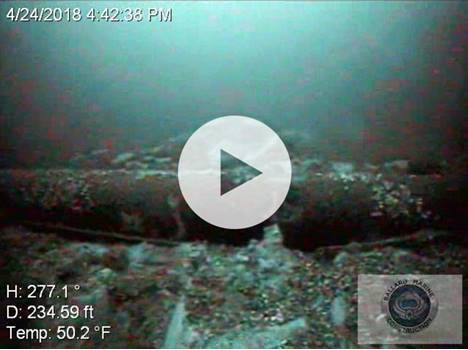
Video evidence of damage to the Line 5 east and west pipelines provided to the Senate Commerce Committee can be watched by clicking here.
Photos documenting the damage can be found by clicking here.
Last year, President Trump signed into law a provision led by Peters to establish a U.S. Coast Guard National Center of Expertise for the Great Lakes to examine the impacts of oil spills in freshwater environments and help develop effective responses. This was in response to the then-Commandant of the Coast Guard telling Peters at a hearing that the agency was not prepared for an oil spill in the Great Lakes, saying that more science and research must be done.
In 2016, Peters helped pass bipartisan legislation reauthorizing the federal agency overseeing pipeline safety, which included provisions designating the Great Lakes an unusually sensitive area, subjecting the Great Lakes basin to higher standards for safe pipeline operation, and improving oil spill response plans to address ice cover.
###