Ranking Member Peters Discusses 2020 Census, President Trump’s Executive Order on MSNBC
Peters Calls President Trump’s Executive Order Use of Data “Something that the American People Didn’t Bargain For”
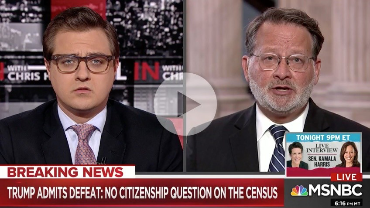
WASHINGTON, DC – Yesterday evening, U.S. Senator Gary Peters (D-MI) joined Chris Hayes on MSNBC to discuss the Trump Administration’s decision to abandon their pursuit of the citizenship question on the 2020 Census and their new proposal to seek citizenship information from existing federal records.
Senator Peters is the Ranking Member of the Senate Homeland Security and Governmental Affairs Committee, which has jurisdiction over the management and oversight of the United States Census Bureau.
On the President’s Executive Order: “I’m not sure what he’s going to do, but that raises a whole host of issues related to privacy, security of that data. And some of that data was given to agencies for one purpose and it may be transferred to another purpose, and that’s certainly something that the American people didn’t bargain for.”
On the need for an accurate count: “You’ve got substantial federal resources that come to states as a result of the count. You’re talking about the very core aspects of our democracy when it comes to representation. And experts who deal with the census every day – those that have testified before my committee – were concerned about the undercount. In fact, the economists at the Census Bureau themselves thought you’d probably have several million folks not counted, probably 9 million people or more.”
On the Trump Administration’s decision to abandon the citizenship question: “I am pleased that the citizenship question won’t be on the census. It’s absolutely critical that every person in this country is counted. It’s outlined in the Constitution. The Supreme Court verified and actually called what the Trump Administration was doing a contrived plan to put something on the census form that would actually have political repercussions and not really be focused on what the intent of the census is, which is to count every individual in the country.”
You can watch the full clip by clicking here.
###